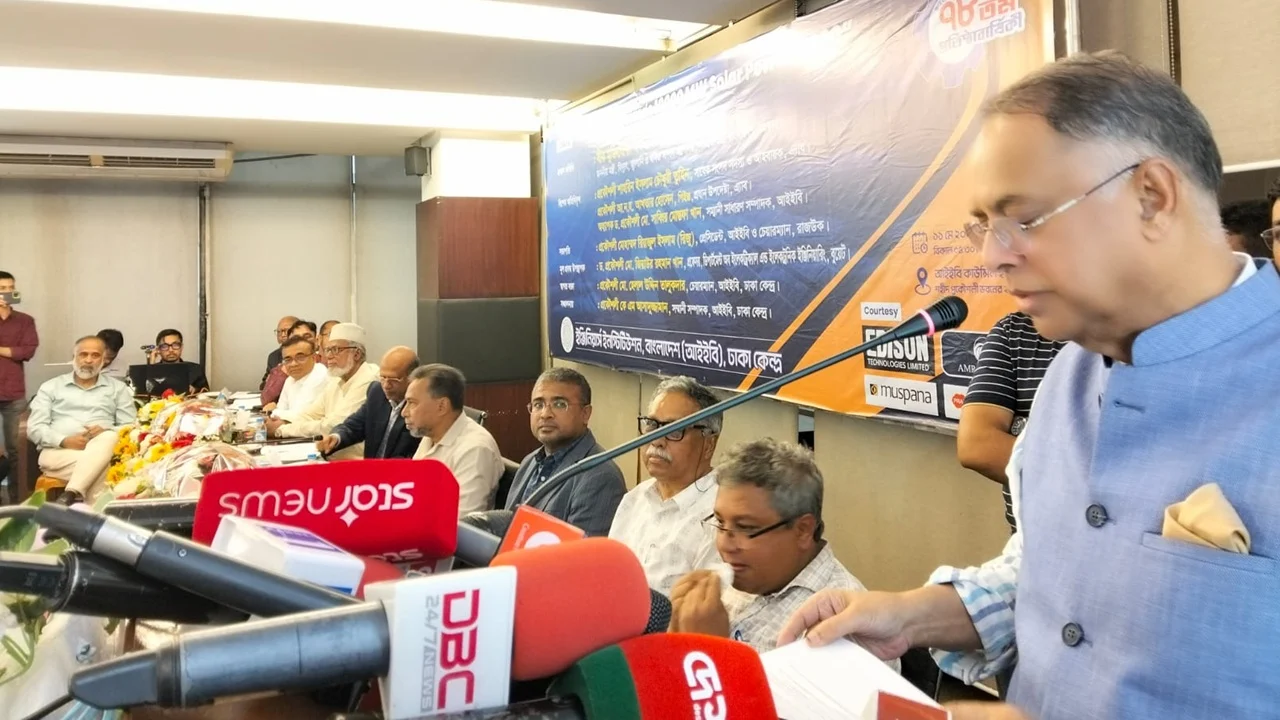
Power, Energy and Mineral Resources Minister Iqbal Hasan Mahmud has announced plans to generate 5,000 megawatts of electricity from solar energy in the next five years.
Highlighting the government’s goodwill on solar power, the minister said that Prime Minister Tariq Rahman raised the issue of solar power in his second cabinet meeting after taking charge. He asked us for a specific plan on how to increase solar power generation.
He said these things at a seminar organized by Dhaka Center on the occasion of the 78th founding anniversary of Engineers Institution, Bangladesh (IEB) in Dhaka on Monday afternoon.
President and Chairman of IEB, Rajuk Engineer Mohammad Riazul Islam (Riju) presided over the seminar titled ’Roadmap Towards 10,000 Mowgawatts Solar Power, 2030’ in the council room of IEB New Building.
In the speech of the chief guest, the power minister said that the previous government had made the power and energy sector dependent on imports for money laundering. That is why 56 thousand crore rupees have now become a liability in this sector. Which the current government has to bear. During the previous government, they had stipulated the installation of solar panels on the roof for solar power connection. But no one installed the saular properly. Set up for display which did not work. Now there is dust.
Following the business and profitable model, he highlighted the plan to install solar power panels on the roofs of houses everywhere including Dhaka city and said, if Dhaka can be divided into six or several other blocks. If each investor can be given a block. The investor himself will generate electricity and sell it at the private level. The government will not give a hand here.
When the bureaucracy hits somewhere, the work there becomes slow. In this way we will increase the production of solar power. Now it is necessary to declare the solar project tax free. If someone comes into business using this facility after five years, the government can collect income tax from him. I don’t see any problem with that, added the minister.
Highlighting the idea of introducing solar electricity on the roofs of houses, Iqbal Hasan said that if someone installs a certain amount of solar electricity in his house, his holding tax can be waived or reduced. This will revolutionize the solar power sector. Government will provide policy support, this is our policy.
Highlighting another plan to install solar panels on government land, the minister said that a lot of land in the Ministry of Railways is lying vacant. People are taking over and eating. A lot of land in the road department is lying vacant. The Ministry of Lands has a lot of special land. Solar panels are being considered in these lands.
Professor of Electrical and Electronic Engineering Department of BUET presented the main article in the seminar. Mo. Ziaur Rahman Khan. He said that currently the contribution of renewable energy in the country is about 5 percent, but the target has been taken to increase it to 30 percent by 2030. For this, from the current capacity of about 1.5 GW, it should reach 10 GW quickly.
Analyzing the examples of Vietnam, India and Pakistan, the article shows that while rapid solar power expansion is possible, it is not sustainable without a strong grid and policy support. Vietnam added 16.5 GW of solar power in two years, but the weak grid caused huge power wastage. India, on the other hand, has succeeded in reducing solar power costs through competitive auctions and “plug and play” infrastructure.
In the case of Bangladesh, solar home system, solar irrigation pump and net metering in the garment sector are highlighted as successful initiatives. However, land shortages, high import duties, procrastination and approval complications have been identified as major obstacles. Ziaur Rahman pointed out that high duty on solar panels, inverters and batteries is discouraging investment at present.
The article emphasizes coordination of solar power with agricultural land, floating solar projects in Kaptai Lake, tariff withdrawal and smart grid and battery storage systems. Apart from this, it has also been proposed to create investment opportunities for community solar, green bonds and expatriates.
AB convener and former Member of Parliament Engineer Shahreen Islam Chowdhury Tuhin, Chief Advisor Engineer A.No.H. Akhtar Hossain, IEB Honorary General Secretary Professor Dr. Engineer Md. Sabbir Mustafa Khan and others.
As